In Greater Charleston, “advanced” should mean more than a cleaner sit or a longer down-stay. It should mean your dog can heel past dropped food at a farmers’ market, ignore another dog on a tight boardwalk, disengage from shorebirds at the beach, and come back when the world gets loud, windy, and exciting. That is what we mean when we talk about advanced obedience training.
For many of our clients, that standard matters most in the island communities that shape daily life near the water, including James Island, Johns Island, Daniel Island, Wadmalaw Island, and Kiawah Island. These are places where dogs are part of outdoor routines, beach mornings, open-air events, and social weekends. They are also places full of moving distractions, layered smells, wildlife, food, and people.
At Activate Canine, we prepare dogs for that reality. We use advanced off-leash training and structured board-and-train progression to build the kind of reliability that still holds up when a dog is excited, overstimulated, or tempted. We are not chasing obedience that only works in a quiet room. We are building obedience that travels. Our dog training services are built around that real-world progression, with board-and-train options, owner hand-off lessons, and ongoing support.
What Advanced Obedience Training Actually Means
Advanced obedience training is not just beginner obedience with fancier branding. It is not a dog that can perform a few commands when nothing interesting is happening. It is a dog who understands the work deeply enough to stay responsive under pressure.
For us, advanced obedience training means several things working together. It means a dog can heel with intention instead of drifting. It means recall still matters when motion, scent, or social excitement pulls attention away. It means “place” is not just a trick but a practical skill that helps a dog settle near a towel, patio table, or market booth. It also means the dog can recover quickly after being startled, aroused, or distracted.
A lot of owners think “advanced” means adding more commands. In real life, advanced usually means better emotional control, faster reorientation to the handler, and more accountability in difficult spaces. We build those outcomes by starting with clear fundamentals, then raising distraction in layers. Our flagship programs include regular updates, owner hand-off lessons, and a lifetime guarantee, so the work does not stop the moment a dog leaves training.
On our site, our Trailblazer package is specifically built for hikers and beachgoers, with highlights that include off-leash for all obedience, advanced obedience, and off-leash recall. That is a useful shorthand for what advanced obedience should deliver in the Lowcountry: not more drama, but more freedom.
Why Advanced Off-Leash Training Matters in Greater Charleston
Advanced off-leash training matters here because Charleston life keeps asking more from dogs than people realize. It is not just one beach trip a year. It is sidewalks, docks, patios, parking lots, open-air events, golf carts, joggers, bicycles, and wildlife.
That is especially true in and around James Island, Johns Island, Daniel Island, Wadmalaw Island, and Kiawah Island. These communities pull people outdoors. Dogs see more marsh edges, birds, beach access paths, neighborhood traffic, and social gatherings than they would in a quieter suburban routine. If a dog is going to earn more freedom in those places, the training has to match the environment.
We do not think of advanced off-leash training as a luxury add-on. We think of it as preparation for a lifestyle. A dog who lives near beaches, trails, and island neighborhoods needs more than a passable recall in the backyard. They need advanced heel work in transition zones, stronger handler focus around movement, and the ability to disengage from prey, other dogs, and food without a fight.
Our obedience page describes off-leash obedience as the point where a dog can come once even when “squirrels tease in Azalea Park or café crowds bustle on Short Central.” That language fits Charleston because it captures the real issue. Off-leash reliability is not tested when nothing is happening. It is tested when everything is happening.
Beach Training Is the Ultimate Test of Real-World Obedience
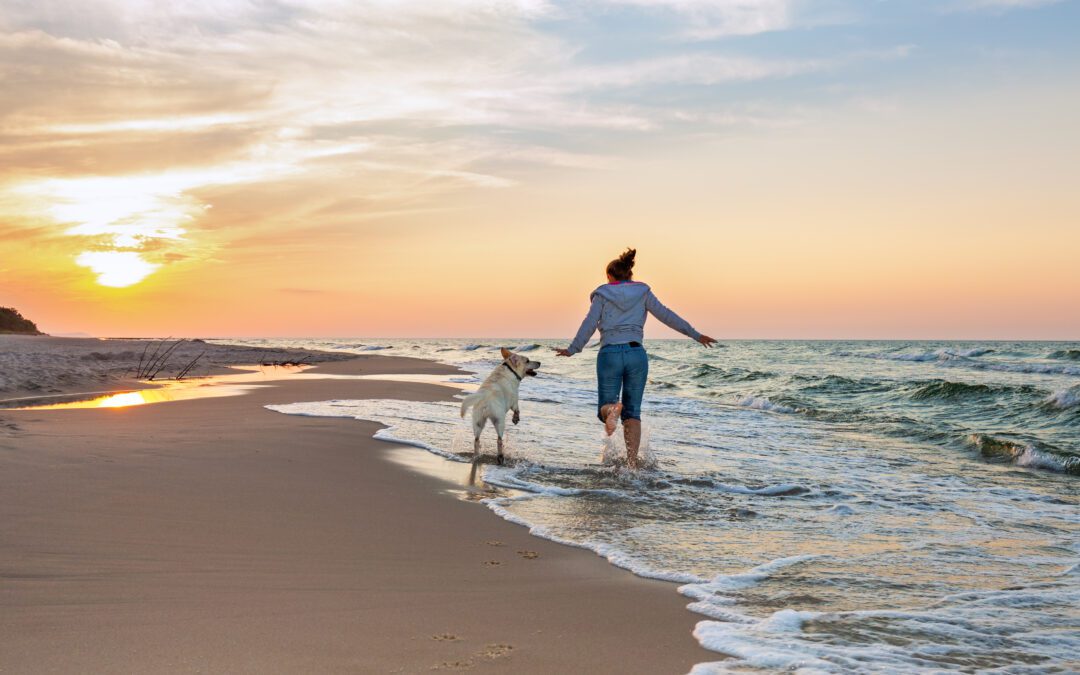
The beach is one of the hardest environments that most pet dogs will ever face. Owners sometimes think of it as a reward after training, but in practice, it is one of the clearest tests of whether training is real.
Why is the beach so hard? Start with scent. Salt air moves differently, wind shifts constantly, food smells travel, and birds leave trails that light up prey drive. Add motion and noise. There are crashing waves, children running, towels flapping, coolers opening, other dogs passing, gulls lifting off, and strangers approaching to say hello. Then add footing. Loose sand changes stride and balance. Hot sand changes tolerance.
That is exactly why advanced obedience training matters. A dog who truly understands heel can move with us through the beach access path and parking area instead of dragging toward every scent cone. A dog with strong place work can settle near a blanket instead of pacing and scavenging. A dog with advanced off-leash training can recall away from a bird flush or another dog because the cue has been proofed against excitement, not just rehearsed in calm.
The beach also demands courtesy and legal awareness. At the Isle of Palms, dogs may be off-leash only during specific seasonal time windows, and owners must keep a leash in hand, maintain voice control, and clean up after their dogs. Charleston County Parks also notes that Isle of Palms County Park has set off-leash windows, while places like Kiawah Beachwalker Park require dogs to stay leashed and under control, and Folly Beach County Park requires leashes and bars dogs during certain daytime hours in peak season. Those rules matter for safety, wildlife, and keeping dogs welcome in public spaces. See the official Isle of Palms dog rules if you want the exact beach schedule before you go.
We train with those realities in mind. We do not treat beach work like a cute field trip. We treat it like advanced proofing. If a dog is going to handle surf noise, wind, birds, food smells, and social pressure with confidence, we have to build the obedience to support that long before the leash comes off.
Farmers’ Markets, Flea Markets, and Craft Fairs Challenge Dogs in Different Ways
Owners often talk about “crowded places” as if they are all the same, but they are not. Farmers’ markets, flea markets, and craft fairs each challenge dogs in distinct ways, which is why advanced obedience training has to be scenario-specific.
Farmers’ markets are usually the hardest for food-driven dogs. The temptation is everywhere. There are meat smells, produce smells, samples, dropped crumbs, bags swinging at nose level, and people who stop suddenly in narrow lanes. The chaos is not just visual. It is edible. A dog who looks steady in a quiet heel can start forging badly once the air is loaded with food.
Flea markets create different kinds of pressure. They tend to be visually cluttered and spatially inconsistent. Aisles narrow without warning. Strange objects sit low to the ground. People bend, rummage, pivot, and move unpredictably. That means the dog needs body awareness, patience, and a stronger response to leash guidance.
Craft fairs can be deceptively difficult. They may look calmer than farmers’ markets, but they often include tents flapping in the wind, displays that move unexpectedly, and textures or smells some dogs find fascinating. Minimally processed animal fibers, wool goods, leather items, and handmade treats can all create a different kind of excitement. Many dogs also get extra social pressure there because people want to step in close, compliment them, and break their focus.
We prepare dogs for each of these spaces differently. At a farmers’ market, we care a lot about anti-scavenging discipline, patient heel work, and place while the handler talks or pays. At a flea market, we care more about calm navigation and startle recovery. At a craft fair, we care about neutrality around unusual materials and social interruptions.
Other Dogs, Potential Prey, and Moving Triggers Are Different Problems
One of the biggest mistakes owners make is assuming that distraction is all one category. It is not. A dog who can ignore another dog may still lose their mind over a bird. A dog who can heel past people may still break on a bicycle. A dog who recalls off a squirrel in one setting may still struggle when another dog is involved. These are different problems, and advanced off-leash training has to address them separately.
Other dogs often trigger social excitement, frustration, or defensiveness. Some dogs want to greet. Some want to control space. Some become vocal because they are conflicted and overstimulated. Training for dog neutrality is not just asking for a sit while another dog passes. It is teaching the dog that another dog’s presence does not change their job.
Potential prey is different. Birds, squirrels, rabbits, and fast shoreline movement tap into chase patterns that can override mediocre recall. That is why beach work is so revealing. Shorebirds and gulls move erratically, and many dogs have a much stronger response to that motion than owners expect.
Fast-moving triggers such as runners, kids, skateboards, bikes, and golf carts create yet another problem. Motion alone can pull a dog out of obedience if the dog has only been trained around static distractions. This is why our advanced off-leash training does not stop at generic field trips. We work with dogs through layers of dog exposure, prey-style movement, and fast traffic patterns so owners can understand which category is hardest for their dog.
How We Build Advanced Obedience Training at Activate Canine
We build advanced obedience in layers. We do not start with chaos, and we do not expect dogs to figure out high-stress environments through sheer repetition. We create clarity first, then distraction, then accountability.
That process starts with foundation work. We want leash clarity, real understanding of heel, a dependable place command, solid down and sit work, and a recall cue that already means something to the dog. Once those pieces are in place, we expand the environment. We move into controlled public work, longer duration, harder temptations, and more complicated transition zones. Then, when the dog is ready, we work through advanced off-leash training with long lines, thoughtful field exposure, and real-world proofing.
Our programs are built for that progression. The Trailblazer package is aimed at hikers and beachgoers and includes advanced obedience and off-leash recall. Our site also notes that our obedience programs include multiple outings to test training in the real world. That matters because beach reliability, market reliability, and neighborhood reliability are not earned in one perfect session. Explore our owner-first coaching approach and our obedience services if you want to see how we structure that progression.
Owner transfer matters just as much as the dog’s training. On our homepage, we say training sticks only if it works for you, and that we provide owners every detail of how to work with their dog. That owner-first coaching is a big part of why advanced obedience holds up after a board-and-train stay. We also include regular updates, owner hand-off lessons, and unlimited refreshers for the life of the dog as long as homework continues.
Signs Your Dog Is Ready for Advanced Off-Leash Training
Not every dog is ready for advanced off-leash training right away, and being honest helps owners make better decisions.
A dog is usually ready to begin this kind of work when they already have a meaningful obedience foundation. We want to see a recall that works on a long line, a heel that stays intact in low-distraction public spaces, and enough engagement for the dog to reorient quickly when it notices something exciting. We also want to see some emotional recovery. A dog does not have to be perfect, but they should be able to come back down instead of staying frantic.
Signs a dog is not ready yet are just as important. Weak recall, scavenging, fragile leash work, nonstop environmental scanning, or a tendency to tip into total overstimulation around dogs, prey, or movement all suggest the foundation needs more work first. That does not mean the dog cannot get there. It means freedom has to be earned in the right order.
What Owners in Charleston’s Island Communities Should Prioritize First
If you live on James Island, Johns Island, Daniel Island, Wadmalaw Island, or Kiawah Island, and you want your dog to enjoy more freedom, the first priorities are usually the same.
Start with recall. Not “comes eventually,” but comes with intent. Then build a calm heel that still works when the environment gets interesting. Add place, because the ability to settle is one of the most practical skills a dog can have on patios, at gatherings, and near the beach. Then work on dog neutrality and prey disengagement, because many off-leash failures happen when a dog notices something biologically or socially exciting before the owner does.
These skills matter before “freedom” does. Local parks and beach regulations make that obvious. Johns Island County Park requires dogs to stay on non-retractable leashes, James Island County Park requires leashes outside the designated dog park, and Kiawah’s beach rules require control, leash possession, and attention to seasonal restrictions. The environment is beautiful, but it is not casual.
Making a Decision
Advanced obedience training should make life in Greater Charleston bigger, easier, and safer. It should help a dog move through beaches, markets, island neighborhoods, dog encounters, prey distractions, and everyday chaos without losing the plot. That is the standard we care about.
The beach is one of the clearest tests of that standard because it combines scent, motion, noise, wildlife, social pressure, and legal expectations all at once. But it is not the only test. Farmers’ markets challenge food impulse control. Craft fairs challenge environmental neutrality. Other dogs, birds, bikes, and golf carts all expose different cracks in a dog’s training.
That is why we approach advanced off-leash training as a real-world progression rather than a gimmick. If you want a dog who can handle the beach, the market, and everyday life in Greater Charleston with more confidence, we would love to help. Schedule a consultation with us, and we can talk through whether your dog is ready for advanced obedience training, advanced off-leash training, or the stronger foundation that gets them there.